reShapr on apple/container: One VM per Container on Your Mac

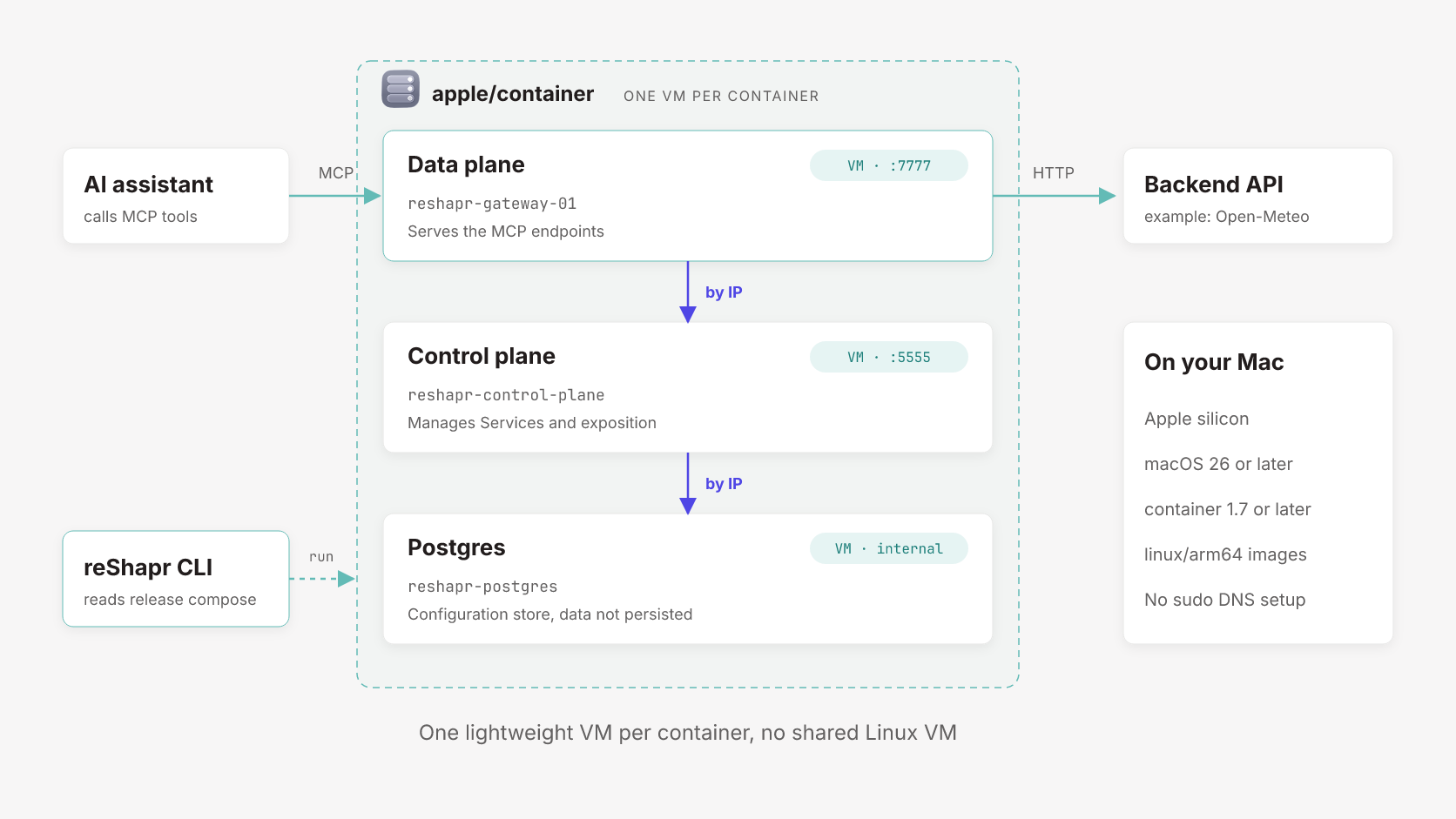
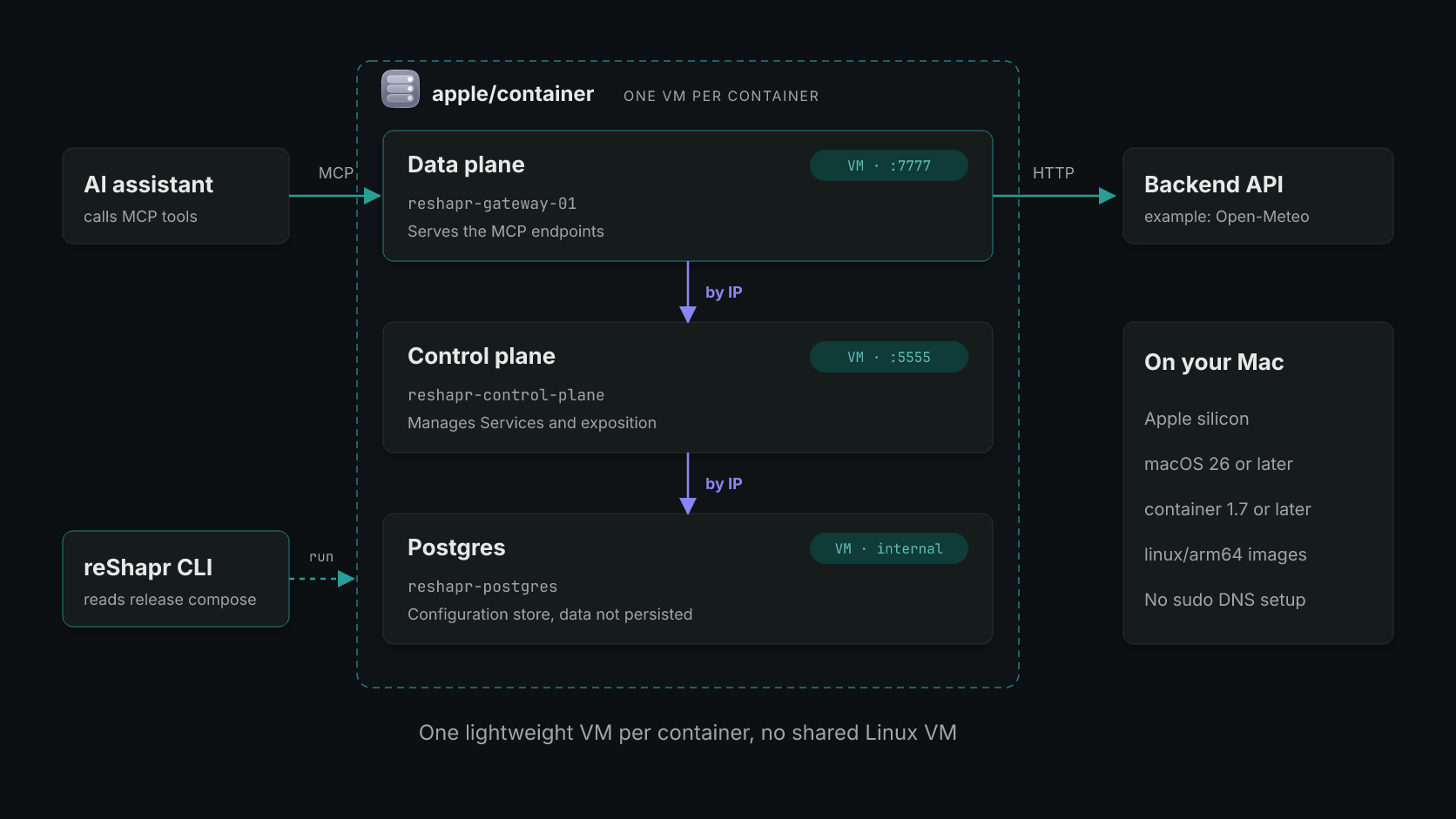
Most of us build MCP servers and agents on a Mac. Until now, running reShapr on that Mac meant Docker Desktop or Podman. Containers need a Linux kernel, so these tools start one Linux VM and run every container inside it, sharing that kernel. The VM starts with the app and stays around while you work.
Apple ships a different model. apple/container is an open source tool, written in Swift, that runs each Linux container in its own lightweight VM on Apple silicon, with only small engine services resident when no container runs.
We added it to reShapr as a third engine: reshapr run --engine apple. Here is what that means, what we measured against Docker Desktop, and where it still falls short.
TL;DR reShapr 1.2.0 adds apple/container as a third engine (reshaprio/reshapr#620), selected with
--engine apple. It is not faster than Docker Desktop. It costs almost nothing when idle and isolates each container in its own VM. The numbers below come from reShapr 1.2.0. The proof of concept ran the same stack on 1.1.0 and 1.1.1 before the release.
Why a Mac-native engine
The Mac is where many of you try reShapr first: a laptop, an assistant, an API you want to expose as MCP tools. The quickest path was Docker Compose, which still works and stays the default.
apple/container changes two things for that laptop experience:
- One VM per container. Each container gets its own kernel and its own memory limit, so containers are isolated from each other by a hypervisor boundary and not only by namespaces.
- No always-on VM. The engine's own services stay small. A shared Linux VM and a desktop app are not part of the picture.
What we built
reshapr run --engine apple reads the same release compose files as the Docker engine. It starts each service with container run in depends_on order, replays the compose healthchecks inside the container, and wires the containers together by IP, so no sudo DNS setup is needed.
Engine auto-detection tries Docker first, then Podman, then apple/container. Existing setups keep working unchanged, and --engine apple selects the new one explicitly.
What we measured
The question: what does it cost to run the same reShapr stack on each engine, on the same Mac?
The stack is the default one: data plane, control plane and Postgres, release 1.2.0, started with reshapr run --release 1.2.0 --engine apple or --engine docker.
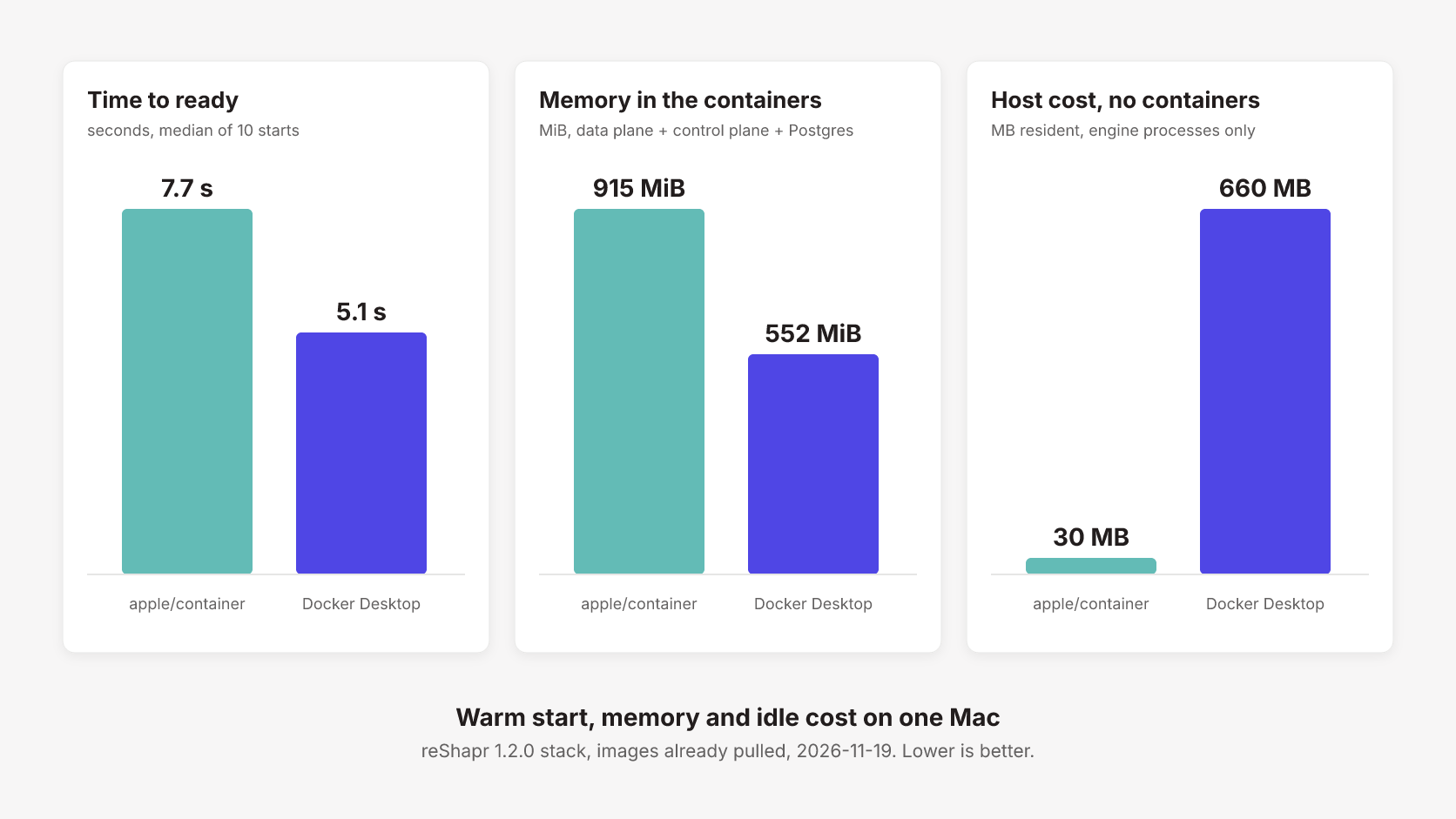
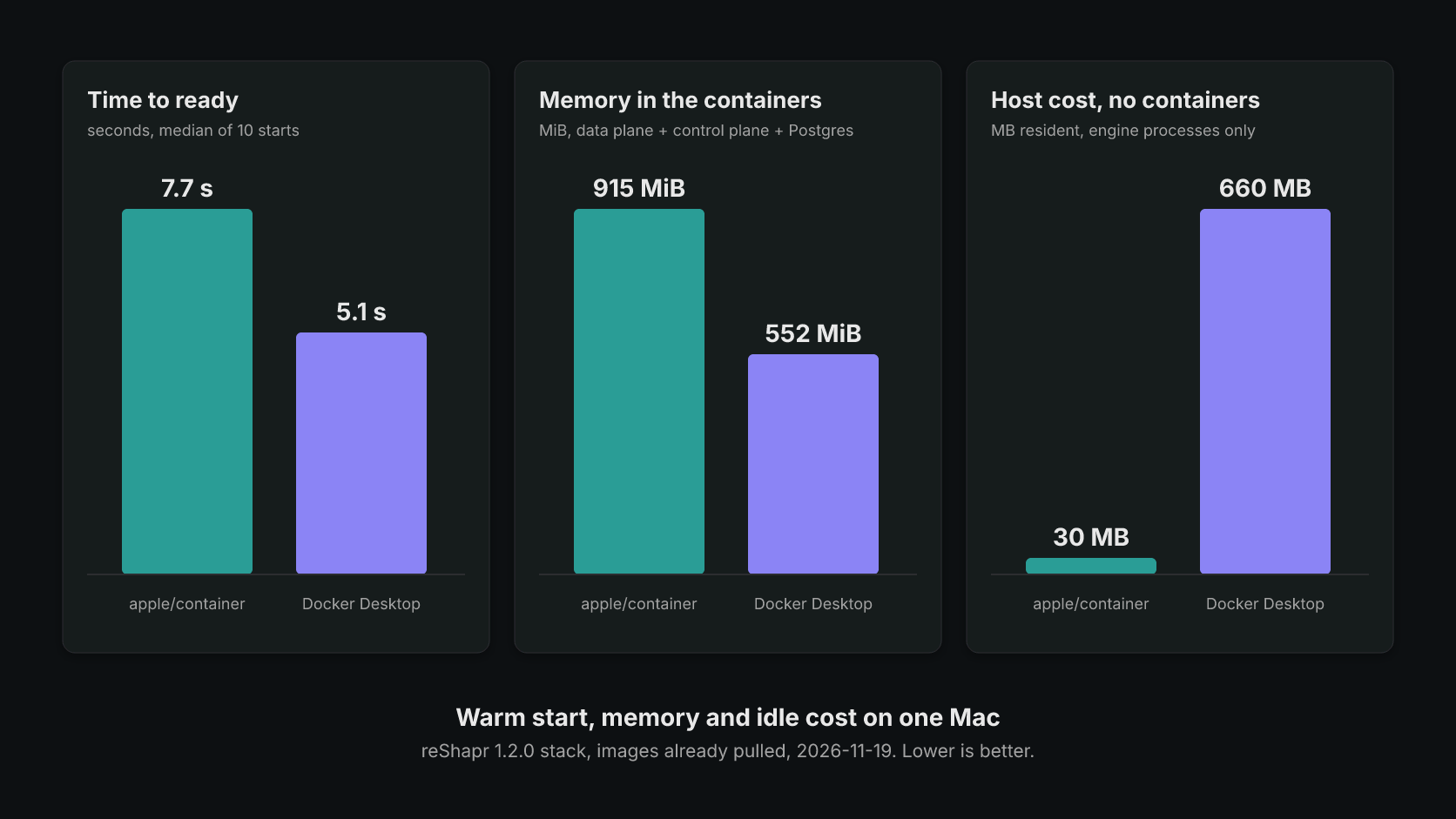
Measured on 2026-11-19 on one Apple silicon Mac (macOS 27.2.1, 24 GB), with reShapr 1.2.0, apple/container 1.7.1 and Docker Desktop 4.99.0 (Engine 29.9.3). We ran two series of 5 warm starts per engine and report the 10 starts together.
| apple/container | Docker Desktop | |
|---|---|---|
| Time to ready, 10 warm starts | 6.4 to 9.0 s (median 7.7 s) | 5.1 to 5.2 s (median 5.1 s) |
| Memory inside the containers (data plane, control plane, Postgres) | 286 to 291, 485 to 486, 141 MiB (913 to 917 MiB total) | 197 to 199, 326 to 330, 26 MiB (551 to 553 MiB total) |
| Engine processes on the host, no container running | about 30 MB | about 660 MB |
Reading these numbers honestly:
- Start time: apple/container is about 2.6 seconds slower in this test. Starting three VMs costs more than starting three containers in a VM that is already running. Docker's start time barely moved between runs, while apple/container varied from 6.4 to 9.0 s.
- Memory in the containers: apple/container is higher on all three services, most on the control plane (485 against 328 MiB) and Postgres (141 against 26 MiB). Each container carries its own Linux kernel and page cache. Both figures were the same in the two series.
- Idle cost: this is where it wins. With no container running, the engine's services hold about 30 MB. Docker Desktop's app processes hold about 660 MB, and its Linux VM adds more on top.
- Host total with the stack up: we do not report it. The resident size of the VMs changed by more than 1 GB between our two series, because macOS compresses idle VM memory, so a
pstotal does not support a comparison.
Method
Only warm starts are timed. We pulled all the images on both engines first, then measured start to readiness. A pull depends on the network and on layers already cached, so mixing it into the start time would measure the registry and not the engine. For the record, the first pull of the three images took about 64 seconds on apple/container; we did not benchmark Docker's pull, because Postgres and shared layers were already cached.
Each cycle runs reshapr run --release 1.2.0 --engine apple (or docker), polls both /q/health/ready endpoints until they answer 200, then runs reshapr stop. Memory is sampled 30 seconds after the last start of each series.
Fairness caveats
- One machine, one day, two series of five starts per engine. Treat the figures as orders of magnitude, not as a verdict.
- Container memory comes from
container statsanddocker stats. Idle host memory is resident size fromps, approximate, sampled once per series. - Docker Desktop's idle figure is its desktop app and helper processes. Its VM is sized for the whole machine (8 GiB here) and is not included, because its resident size varied too much to compare. apple/container gave each container a 1 GiB limit by default.
- An earlier series on reShapr 1.1.1, which started the apple/container stack with our proof of concept scripts, gave 10.4 s against 7.1 s. The difference with today's numbers comes from the release, the start path and the state of the machine, and we did not isolate them.
What the proof of concept showed
Beyond the numbers, we wanted to know whether reShapr works the same on this engine. To find out, we built a proof of concept in a GitHub repository: yada/reshapr-container-poc. It holds the scripts that start the stack on apple/container and records each check, run on macOS 27 with reShapr 1.1.0 and 1.1.1:
- MCP end to end.
initialize,tools/listandtools/callwork through the data plane, against a public API (Open-Meteo, used as an example). - Hardened control plane. In the PoC, it runs with
--read-only --cap-drop ALL --tmpfs /tmp;--engine appledoes not set these flags. - Two clustered gateways. In the PoC, two data plane replicas form one cluster inside a
container cluster; the benchmark stack runs a single one.
Limits to know before you start
- Postgres data is not persisted yet. The engine ignores compose
volumes, so stopping the stack resets the configuration. Docker keeps it because the release compose file mounts~/tmp/reshapr-data. The gap is in the engine, not in apple/container: in our test, a Postgres VM kept its data in a mounted host folder across a restart, as long as the mount targets the parent of the data directory. restartandextra_hostsfrom the compose files are ignored.- No cluster mode with
--engine apple. Two gateways did form one cluster in acontainer clusterwith the 1.2.0 images, but that setup is Kubernetes-style and outsidereshapr run. The PoC has the manifest and steps. It is experimental. - Apple silicon and macOS 26 or later only, with container 1.7 or later.
- The engine is available from reShapr 1.2.0. The proof of concept scripts predate the release and run the same stack on earlier ones.
Try it
With reShapr 1.2.0 or later, the flow is the same as with Docker. The full procedure, with its limits, is in the apple/container guide.
container system start
reshapr run --engine apple   # uses the latest release; pin one with --release 1.2.0
reshapr status
reshapr stop
What changed
- reShapr has a third engine, native to the Mac, selected with
--engine apple. - The stack runs as three VMs, and only about 30 MB of engine services stay resident when it is stopped.
- It is slower to start and heavier per container than Docker Desktop in our test, and much cheaper when idle.
- The limits are known and listed: no persistence, no restart, no cluster mode.
If you build on a Mac and want to try it, follow the apple/container guide and open an issue with what you hit. To learn more about the engine, see the apple/container repository. For the Docker path, see the Docker Compose guide.