Demos
Use these short videos to see a reShapr workflow before following its written procedure. The written alternative is the maintained source for commands, prerequisites, and current product behavior.
View the reShapr channelStart and expose an API
Install reShapr locally, start its components, and expose an OpenAPI service as an MCP endpoint.
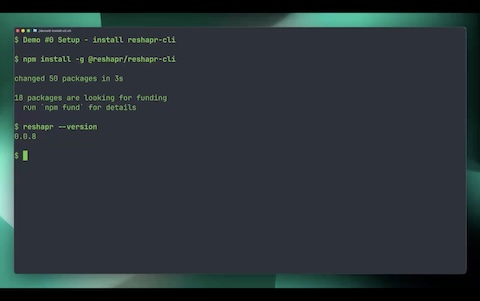
Install the reShapr CLI
Prerequisite: Node.js 20 or later.
Result: the reshapr command is available locally.
Historical recording · Follow the current written procedure.
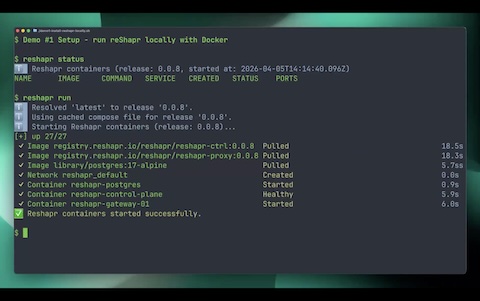
Run reShapr locally with Docker
Prerequisite: the reShapr CLI and Docker or Podman.
Result: the local reShapr components are running.
Historical recording · Follow the current written procedure.
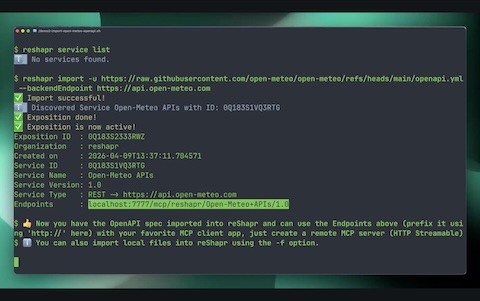
Import Open-Meteo and expose it through MCP
Prerequisite: a running reShapr environment and the CLI.
Result: an OpenAPI service is available through an MCP endpoint.
Historical recording · Follow the current written procedure.
Apply Context Control
Reduce and reshape a GitHub GraphQL API into focused MCP capabilities.
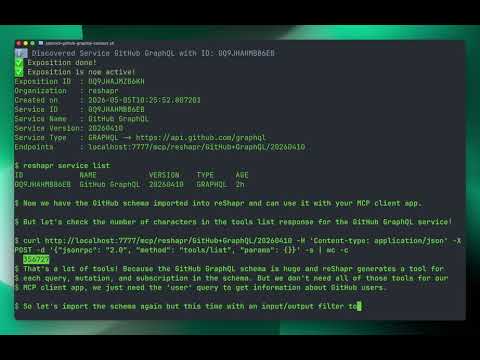
Apply Context Control to GitHub GraphQL
Prerequisite: a GitHub GraphQL service imported into reShapr.
Result: the exposed MCP surface contains only task-relevant capabilities.
Reference demo · Replay not verified against current baseline reShapr 1.0.0.

Add Prompts to a controlled GraphQL surface
Prerequisite: an exposed GitHub GraphQL service.
Result: an MCP Prompt guides a client through the focused workflow.
Reference demo · Replay not verified against current baseline reShapr 1.0.0.

Use Context Control with an MCP App
Prerequisite: a GitHub GraphQL MCP endpoint and a compatible MCP App.
Result: the app consumes the focused capabilities exposed by reShapr.
Reference demo · Replay not verified against current baseline reShapr 1.0.0.
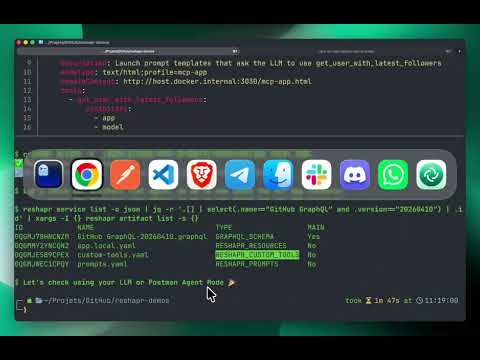
Combine an MCP App with Prompts
Prerequisite: an exposed GitHub GraphQL service with a Prompt Artifact.
Result: the MCP App uses a Prompt to drive the focused workflow.
Reference demo · Replay not verified against current baseline reShapr 1.0.0.
Secure MCP and backend access
Keep MCP client authentication separate from the credentials used by the proxy to call backend APIs.

Elicit a token for GitHub GraphQL
Prerequisite: a GitHub token and an MCP client that supports elicitation.
Result: the proxy receives a credential for authenticated backend calls.
Reference demo · Replay not verified against current baseline reShapr 1.0.0.

Use OAuth 2.0 URL elicitation with Keycloak
Prerequisite: Keycloak, Open-Meteo, and an MCP client with URL elicitation support.
Result: the proxy obtains OAuth credentials for backend access.
Reference demo · Replay not verified against current baseline reShapr 1.0.0.

Separate endpoint and backend OAuth
Prerequisite: OAuth providers for the MCP endpoint and backend API.
Result: client authentication and backend authorization use separate flows.
Reference demo · Replay not verified against current baseline reShapr 1.0.0.
Follow MCP protocol evolution
See how a reShapr MCP endpoint negotiates the current stateless protocol alongside historical session-based versions.

Negotiate MCP 2026-07-28
Prerequisite: a reShapr MCP endpoint and a compatible MCP client.
Result: the client negotiates the stateless protocol mode.
Supported by reShapr 1.0.0 · Video replay not independently verified.
This page covers all 11 public videos visible on the reShapr channel on September 7, 2026. Check the channel for videos published after that date.