From Context Overload to Context Control!


Credit: Yacine Kheddache (KubeCon NA Atlanta)
How reShapr Makes the Model Context Protocol Production-Ready?
When Anthropic introduced the Model Context Protocol (MCP), it provided developers with something they had been missing: a common language for connecting Large Language Model (LLM) and AI agents to existing systems and services.
But as the MCP ecosystem exploded, so did the context windows!
Anthropic’s own engineers recently wrote in “Code execution with MCP: Building more efficient agents” that agents now juggle hundreds or thousands of tools, and that every tool definition and intermediate result consumes tokens, slowing agents, inflating costs, and sometimes even breaking workflows.
At reShapr, we took that exact problem, token consumption and context-window explosion as the starting point of our product design. Before Anthropic formalized the MCP “code-execution” pattern, we asked a more straightforward question:
What if the protocol wasn’t the issue? What if the problem was how we expose APIs to it?
We built reShapr on “tokens first” thinking
Anthropic’s post illustrates two pain points:
- Loading all MCP tool definitions upfront floods the model’s context.
- Intermediate results, even megabytes of JSON or text, must pass back through the model.
Both are symptoms of what we call context coupling: treating the model’s memory as a data bus instead of an intent space. When we designed the reShapr’s No-Code MCP Server, we flipped that pattern. Instead of dumping every API operation and description into the model, reShapr acts as a programmable filter between your existing API services and the MCP interface.
That design allows you to:
- Selectively translate only the operations you need into MCP tools.
- Restrict which tools are visible to which clients, agents, or LLM personas.
- Partition your exposure by business domain, use case, or security zone.
In other words, while the Anthropic team optimized the client-side execution loop, reShapr optimized the server-side surface area.
We shrink the tool universe before the model ever sees it.
One backend, many MCP faces
Here’s where reShapr becomes powerful. From a single backend API service, your CRM, payment gateway, or internal microservice, you can create multiple MCP servers, each with:
- Its own name, tool set, and access policy.
- Its own domain focus (e.g., “finance”, “support”, “analytics”).
- Optional context filtering rules for sensitive data or operations.
Need to give a marketing AI access to campaign metrics but not customer PII? Spin up an mcp-marketing server exposing only /metrics and /reports.
Need a developer agent to deploy builds? Create mcp-devops with deploy, rollback, and status tools.
Same backend, different MCP surface, but zero code.
This domain specialization not only mirrors real business boundaries; it also keeps the model’s working set lean. Why make Claude, ChatGPT, or any other LLM “see” thousands of endpoints if it only needs a few to do what is expected?
Filtering at both ends
Docker’s recent post, “The Model Context Protocol: Simplifying Building AI apps with Anthropic Claude Desktop and Docker”, praised Anthropic’s idea of filtering tool exposure for efficiency and safety. We couldn’t agree more, and we’ve implemented that concept from day one.
Where Docker focuses on local developer control and discovery, a marketplace or container registry of MCP servers, reShapr operates as an AI integration layer in all environments (dev, QA, prod).
Our filters exist not just for discovery, but for policy enforcement.
Think of it as defense in depth for context:
- reShapr filters which APIs become MCP tools.
- It also filters which tools each client or agent may call.
- It even filters which API operations flow, preventing oversharing.
While Docker helps you run MCP servers locally, reShapr enables you to govern them globally by enabling existing API services for the AI Era. The two approaches are complementary, not competing, layers of the same emerging ecosystem.
The context window isn’t infinite, and that’s okay!
Anthropic’s own metrics show that replacing direct tool calls with “code execution” reduced token usage by 98.7 % in their benchmark scenario. That’s impressive, but it’s also proof of the underlying issue: agents today overconsume context because they’re given too much surface to reason about.
At reShapr, we believe, that context discipline beats context expansion. Instead of asking “how can the model handle more?”, we ask “how can we give it less, but more meaningful input?”
Our filtering architecture, domain-specific MCP servers, and selective exposure make it possible to:
- Keep token budgets predictable.
- Maintain shorter prompt-response cycles.
- Scale agent ecosystems horizontally without blowing up latency or cost.
You can call it context-aware architecture or, simply, good software engineering.
Bringing legacy APIs into the AI era
One of the most exciting side effects of reShapr’s design is how easily it modernizes existing APIs.
Take Stripe’s REST API as an example. Its OpenAPI spec is comprehensive and enormous. Exposing it directly to an LLM would create a vast array of endpoints, parameters, and schemas, none of which are optimized for conversational use.
With reShapr, you can wrap Stripe’s API once and expose tailored MCP views:
- mcp-payments exposing only
create charge,refund, andlist customers. - mcp-finops exposing
reconcile payoutsandgenerate statement. - mcp-analytics exposing
top-10 customerswith simplified schemas.
Each of these servers can live side-by-side, derived from the same Stripe backend, yet independently optimized for distinct AI personas or business functions.
That’s what we mean when we say “AI-native by translation, not reinvention.”
No-Code setup, enterprise-grade results
reShapr’s configuration model is intentionally simple:
- Connect to your existing Rest API, GraphQL, or gRPC service.
- Use our interface to select the operations you want to expose.
- Add optional field-level filters, renames, or descriptions.
- Publish, and you instantly have a fully compliant MCP server or workflow of MCP servers.
Behind the scenes, reShapr automatically:
- Generates the MCP schema and metadata.
- Handles auth propagation and error mapping.
- Enforces your security and throttling policies.
- Provides live observability dashboards for every tool call.
What Anthropic’s engineers call “progressive disclosure”, which allows models to discover only the tools they need, occurs naturally in reShapr through configuration, rather than custom code.
Scaling AI with less friction, not more code
Anthropic’s “code execution” pattern is brilliant for power users and developer-friendly agents that can write their own scripts.
But in enterprise environments, most teams don’t want every agent writing arbitrary code in a sandbox.
They want predictability, governance, and measurable efficiency.
reShapr delivers that by externalizing code execution into controlled MCP endpoints rather than letting each agent spin its custom code.
You receive all the benefits, including reduced token usage, efficient data handling, and composable workflows, without the operational risk associated with distributed sandboxes.
And when you do want to give agents controlled compute, reShapr integrates seamlessly with your existing infrastructure: Kubernetes jobs, serverless functions, or dedicated compute pools all behind the same No-Code MCP Server powered by reShapr.
Complementing, not competing, with the ecosystem
Let’s be clear: the work from Anthropic, Docker, and MCP / API Gateway vendors is moving the entire industry forward. Each focuses on a different layer:
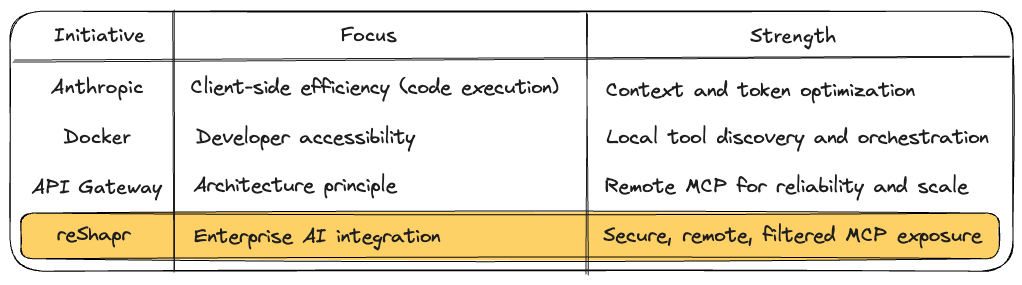
We stand on their shoulders and build the bridge between prototype and production. reShapr is what makes the MCP ecosystem deployable at scale.
Toward a governed, efficient AI integration fabric
As MCP adoption accelerates, organizations face the same maturity curve APIs did a decade ago:
- Experimentation — local prototypes and SDKs.
- Expansion — hundreds of endpoints and tools.
- Governance — access control, observability, cost management.
- Optimization — token efficiency, domain specialization, and security.
reShapr sits squarely at stages 2, 3 and 4. We help teams operationalize MCP servers safely, efficiently, and at scale, without requiring them to rewrite their systems or manually code integrations.
In summary: Control the context, don’t expand it
Anthropic’s Code Execution with MCP article is an important milestone. It demonstrates how agents can be more intelligent about tool usage by converting direct calls into code. reShapr builds on that same insight, but applies it to the entire lifecycle of MCP deployment.
- We anticipated the token and context explosion problem.
- We engineered a system that filters, segments, and secures MCP exposure.
- We deliver remote-first, production-ready servers, not non-realistic experiments.
- We complement Anthropic and others, including Docker, API, and MCP Gateway vendors, by bringing enterprise rigor to the protocol.
In AI integrations, as in good software design, less context is often more powerful.
Ultimately, the goal isn’t to make LLMs see more; it’s to make them see better.